Words by Zee Ahmed
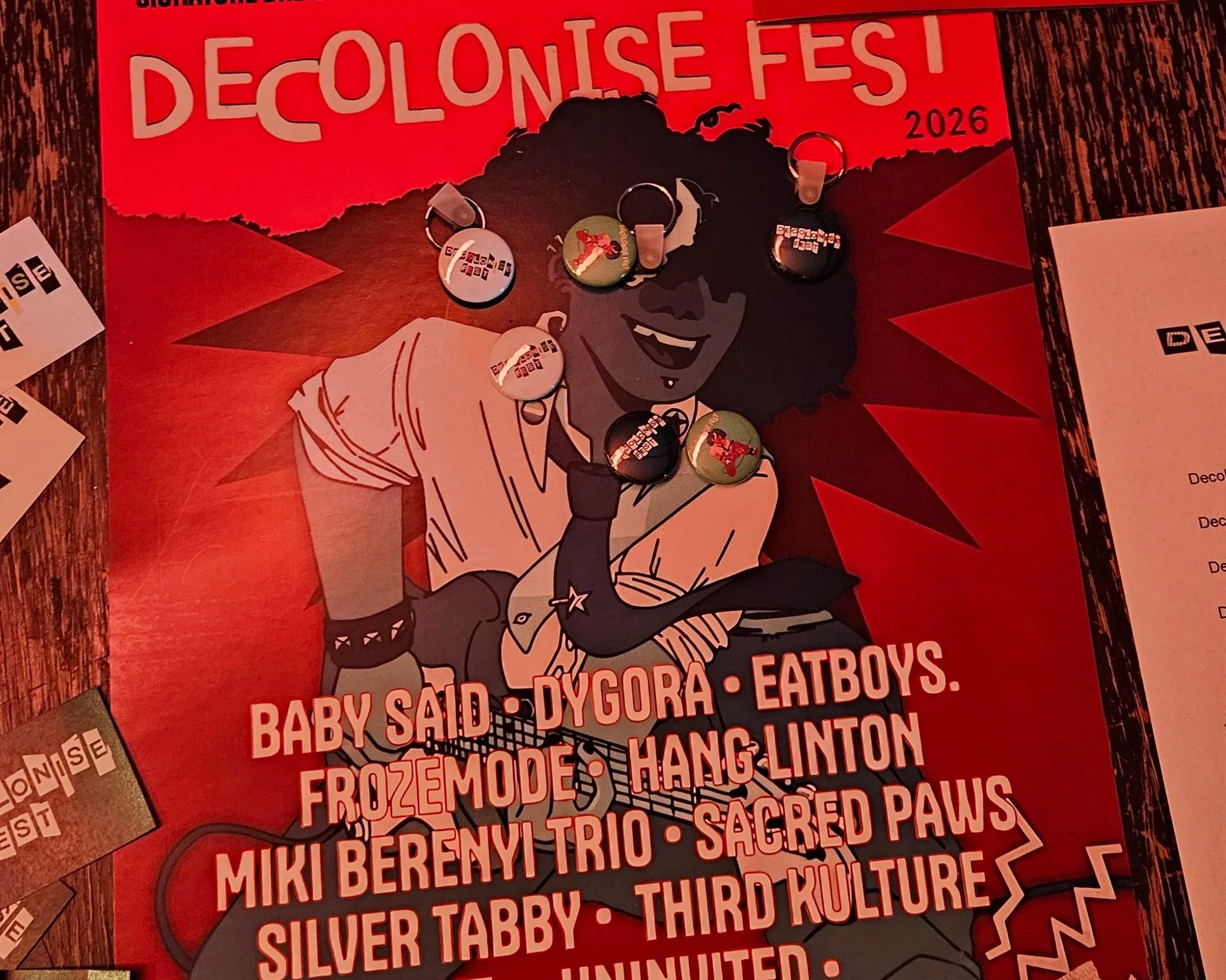
Decolonise Fest 2026 poster
Punks of colour took over Signature Brew Blackhorse Road for this year’s Decolonise Fest, featuring Mashaal and Baby Said on the lineup, for an energetic, expressive and gloriously loud weekend.
Decolonise Fest returned to London this October for a weekend of punk and alternative music, bringing together artists of colour from across the DIY scene. Now in its ninth year, the festivities began with a Friday night launch party at Piehouse Co-op in Deptford, with the festival taking place at its current home, Signature Brew Blackhorse Road, for two days of live music.
Friday night’s launch party featured Floralis, Ish99ni and Princess Xixi, three artists working across different corners of the underground. Scottish Indo-Trinnidadian artist Floralis blended punk, emo and metal influences with electronic beats and politically charged art-pop, while British-Tamil artist Ish99ni brought hyperpop’s glitchy, high-energy sensibility into the mix. Princess Xixi rounded out the lineup with UK drill, bringing another edge to an evening that moved between abrasive electronics, club sounds and rap.
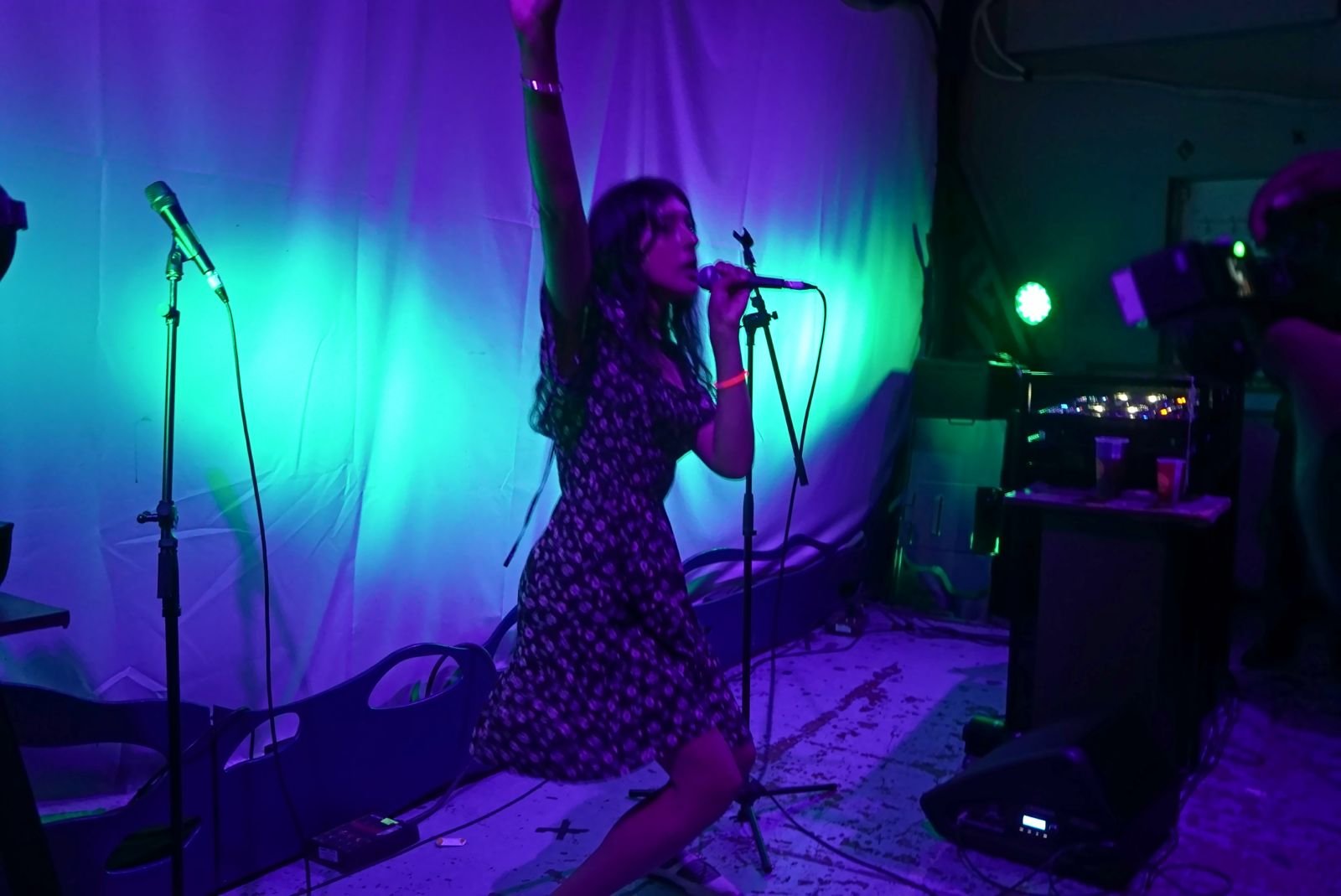
Photo by Zee Ahmed // Ish99ni performing at the Decolonise Fest launch party at Piehouse Co-op
Across the weekend, the lineup moved between punk, hardcore, alternative rock and more experimental sounds. Saturday featured eatboys., Uninvited, Dygora, Third Kulture, Mashaal and Frozemode, while Sunday brought Silver Tabby, Baby Said, tmdistant, Hang Linton, Miki Berenyi Trio and Sacred Paws. There was plenty of variety and the chance to discover bands without knowing quite what to expect was part of the fun.
Mashaal were a particular highlight. They opened their set with Bollywood music, which was such a delight. The familiar sounds spilling into a hardcore punk set made for a brilliant contrast before the band launched into rapid drums, heavy guitars and a raw, gloriously unpolished wall of sound. There was something wonderfully old-school about their approach, recalling the speed and rough-edged urgency of 1980s hardcore.
The Bollywood of “bole choodiyan” from a popular film also had a purpose beyond the musical surprise. We interviewed the band before their set and vocalist Riz Farooqui explained that the band deliberately play Bollywood music while setting up, challenging expectations about what a hardcore show should sound and look like. Having spent decades in the scene, he had often found himself among very few people of colour at gigs. Mashaal formed partly to change that, bringing another dimension to a culture the band loves. Their lyrics, including tracks such as “Terrorists” and “I.M.M.I.G.R.A.N.T.”, confront racism, alienation and the fear experienced by racialised communities in the UK.
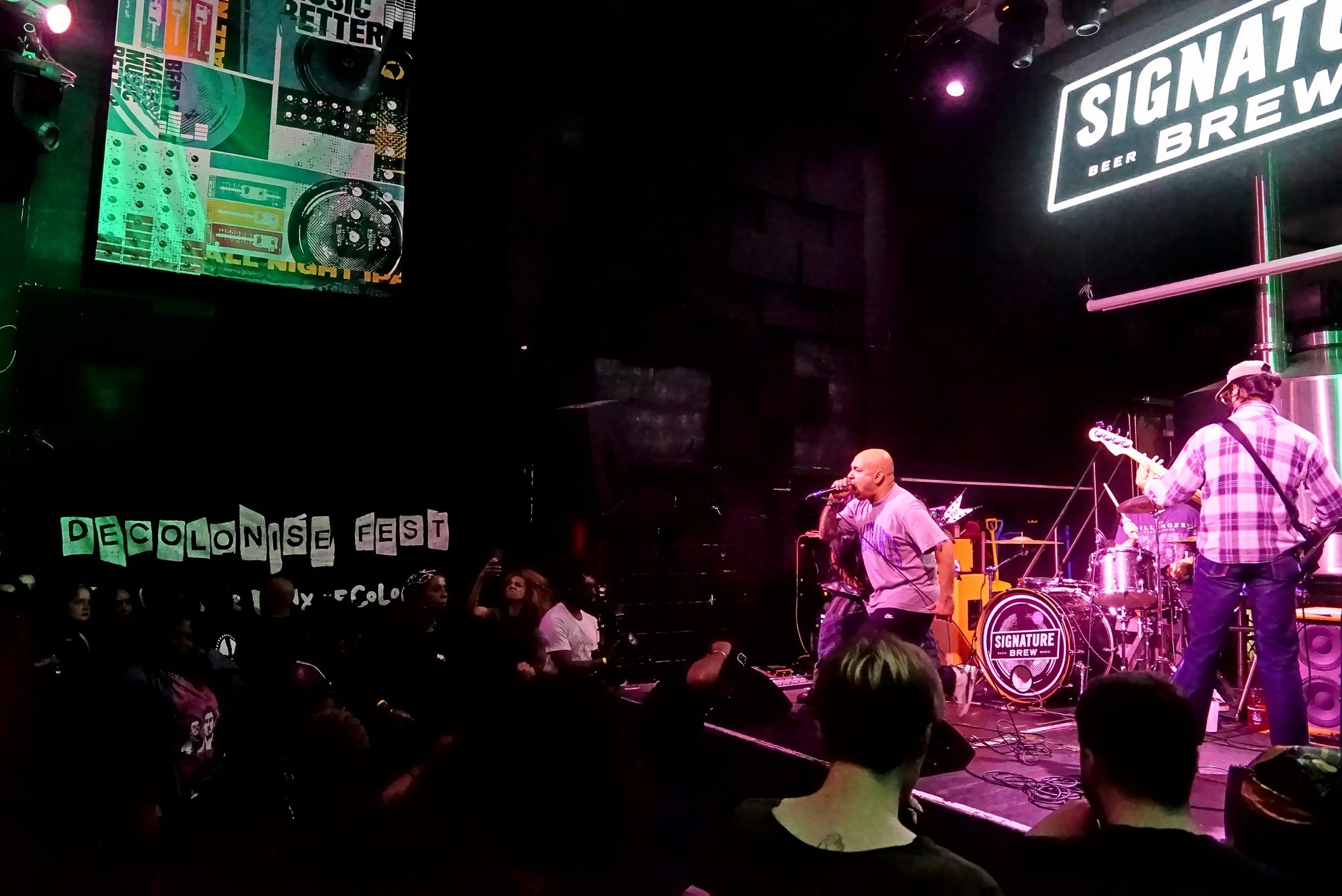
Photo by Zee Ahmed // Mashaal performing at Decolonise Fest at Signature Brew Blackhorse Road
That conviction carried straight into the performance. Mashaal encouraged the crowd to mosh and crowdsurf, and people enthusiastically obliged. The band never stopped engaging with the audience, creating a constant exchange between stage and crowd. The set was aggressive and politically charged, but also hugely enjoyable. It was easy to understand why several people we spoke to afterwards named Mashaal as a highlight of the weekend.
Baby Said brought a different kind of spectacle. They looked fantastic, with a glam-rock aesthetic that brought colour and attitude to the stage. Their guitar-driven alternative rock was built around big riffs and melodic hooks, offering a welcome contrast to Mashaal’s relentless hardcore. We caught up with the Italian-Punjabi sisters, Veronica and Jess Pal, briefly after their set. They told us how playing the festival was empowering and how good it felt to have people of colour coming out to support their music. They hoped Decolonise Fest would reach an even wider audience across the UK.
That sense of recognition came up repeatedly in our conversations. One festival-goer described feeling like an outsider both in alternative music spaces and within their own ethnic community, before finding a room full of people who shared what they had thought was a uniquely personal experience. Others spoke about the freedom of being themselves in a space where they felt understood, rather than out of place.
“people who had barely spoken on Saturday were exchanging details and becoming friends by Sunday”
Decolonise Fest also runs a sound engineering programme, giving people of colour hands-on experience in live sound. One trainee told us they already felt part of “something bigger” after spending the day shadowing the sound engineer. Alongside the music, these activities gave people different ways to take part, connect and find common ground beyond the stage. Workshops and panels offered further opportunities to meet people and share ideas, from exploring the colonial histories of spices to zine making and creating DIY bell instruments, inspired by South Asian musical traditions and folk punk. A member of the collective described watching connections develop over the weekend, as people who had barely spoken on Saturday were exchanging details and becoming friends by Sunday.
The collective behind organising Decolonise Fest has grown. Now with a larger team sharing the workload of organising the festival, the festival continues to go from strength to strength. This is a group of people passionate and dedicated to uplifting Black and people of colour making punk and rock music. Each one volunteers their time and energy to organise this much-needed event, supported by additional volunteers across the weekend. Funding from Arts Council England for a second year also meant bands could be paid fairly.
What stayed with me most was how it felt to be there. The festival was energetic, expressive and gloriously loud, and seeing so many people of colour in the audience made a real difference. I felt more comfortable and at ease than I often do at gigs. There was a particular pleasure in being surrounded by people and music I could relate to, without having to think so much about whether I fitted into the room.
With the festival approaching its tenth anniversary in 2027, we hope it continues to grow. We’d happily do it all again.
About Zee

Zee Ahmed is a London-based research consultant with a love for all things punk, and electronic, particularly DIY music and underground scenes. A former drummer in a DIY post-punk band, she’s now learning bass guitar and is always looking for new music to discover. She’s interested in how identities and culture intersect and how music can be a space for expression, experimentation and resistance.