Interview by Naz Toorabally
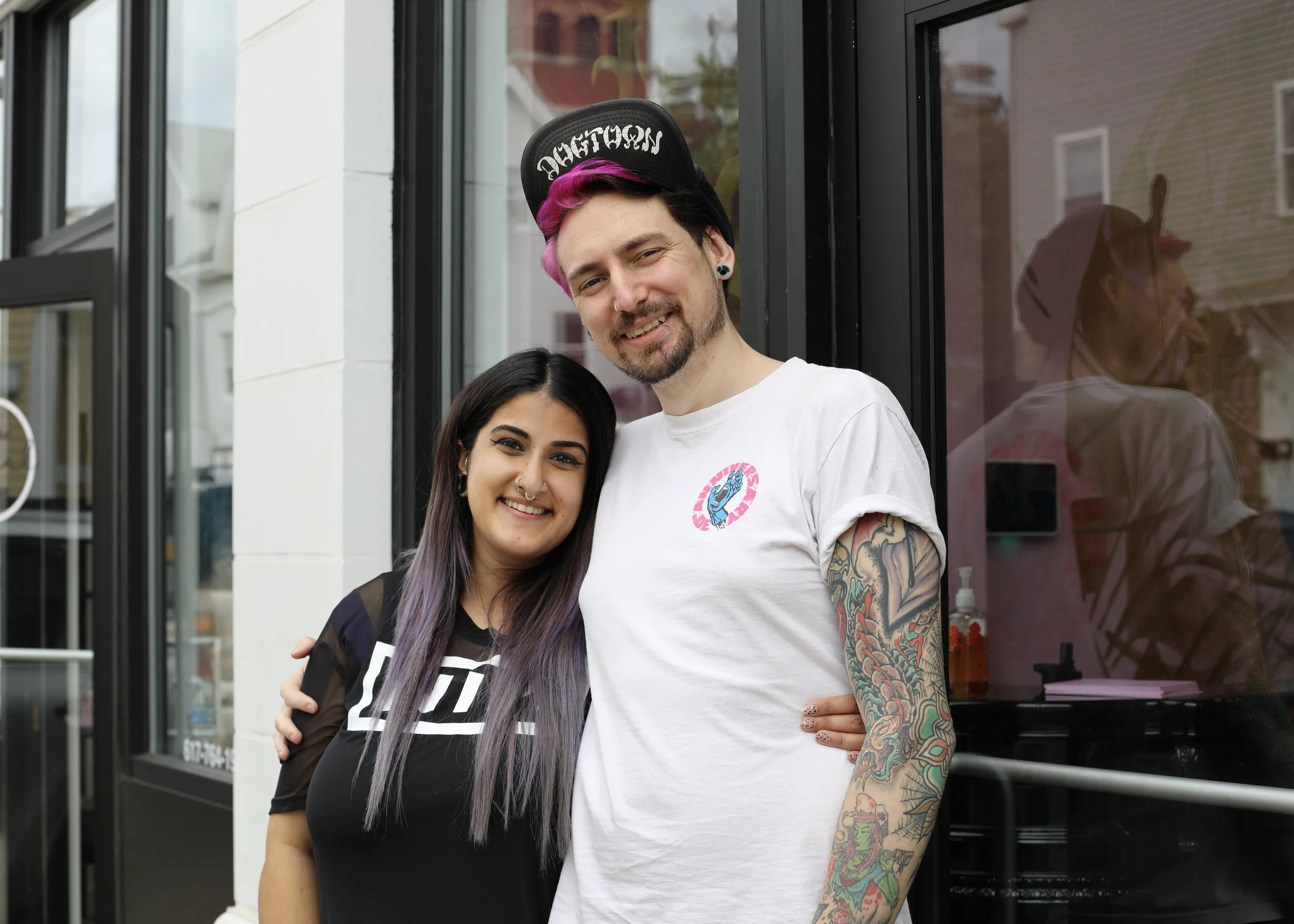
Aisha and Arran, co-owners of Pearl Street Tattoo Club
Aisha Rasool is a British-Pakistani scientist and the co-owner of Pearl Street Tattoo Club, an inclusive tattoo studio in Boston, Massachusetts. Aisha and her husband Arran opened Pearl Street Tattoo Club in September 2022 and have gone from strength to strength. Aisha runs the business-side of the tattoo shop, but her main job is as a placenta scientist – which is what brought them to the US a couple of years earlier.
We caught up over a video call back in the summer of 2022. The interview was originally meant to be published as part of The Fashion Issue, but it never made it to print. Aisha and I, along with her very cute baby, chatted about the beginnings of Pearl Street Tattoo, what it means to run an inclusive tattoo shop and her introduction to the alternative scene.
Naz: Hi Aisha! I'm gonna get straight into it. I really want to know more about your tattoo shop, Pearl Street Tattoo Club, that you and your husband Arran run together. What was the inspiration behind starting it and what is your role?
Aisha: The tattoo shop came about as there hasn't really been, in the Western world at least, much space in tattooing by people of colour, for people of colour and marginalised people in general. Especially not nurturing spaces where artists and clients can feel comfortable just to be themselves and be happy in a tattoo studio space. This is something I've noticed and I've also noticed that people don't really want to make space or don’t know how to make space for BIPOC and marginalised people.
Opening a tattoo shop is something we always wanted to do at some point, but during the pandemic we managed to save up some money and it was our one chance to do it in Boston. We knew of a certain visa to switch to from my postdoc visa ‘cause we were here for my postdoctoral position at Tufts Medical Center and this was our one shot to open a tattoo shop in Boston.
Otherwise we'd have to go back to the UK at the end of my contract. So the money we saved during the pandemic by not going anywhere, not going back to the UK to visit, not doing anything. I'm very privileged that I kept my job and my husband was only out of work for two or three months and he got art commissions during that time, so we wanted to open up the space while we could. It was kind of a now or never situation, especially because I knew I wanted a kid soon. I wanted to spend the money before spending the money was too scary to spend because I needed to save up for the kid. We just threw our whole life savings into the tattoo shop and that's how it came about.
You can see pictures of the grand opening on our Instagram, I think around 200 people came. I know we had about a hundred gift bags and we ran out halfway through the day. So we've had an amazing response to our shop! We've had BIPOC and marginalised clients travel down from other states. We've had people coming in from all over the place to get tattooed at our shop. And I'm trying to make sure that all our clients are as comfortable as possible as well.
N: So your husband is one of the tattoo artists, right? And your role is more behind the scenes?
A: My husband is the head tattoo artist – he's the only cis white male in the shop and that's how we wanted it. We thought about it at length and we thought we'd like to create a space where marginalised folks feel comfortable, especially in tattooing. He's a tattoo artist and I run the whole business aspect of it, including Instagram. We collaboratively make TikToks, but I'm on TikTok a lot more, so I see a lot more of the trends and I'm like, “hey, we should do this, we should do that” we do it that way. And a lot of our clients come from TikTok – we've got a lot of Gen Z clients that way.
“I don't want the onus to be on a disabled person to ask, can you make this accessible? I don't want a BIPOC person to say, can you tattoo brown skin? I don't want an LGBTQIA+ person to come in and be like, do you hate us?”
N: One of the reasons I wanted to interview you was because of the ethos behind your tattoo shop, not many places are outward in terms of being inclusive. On your website you are quite clear in saying that you are anti-racist, pro LGBTQIA+, anti-transphobic, anti-misogynistic, body positive, pro-science and disability, and neurodivergent friendly, which I think is really important.
Can you tell me a bit more about the specific things that you're doing to try and make sure that your shop is as inclusive and welcoming as possible?
A: When we got the shop, we wanted to make sure that it was disability-friendly. We have a ramp into the shop. We thought out how somebody with a wheelchair would be able to get tattooed in the shop. We've had somebody who is a disabled BIPOC person tell us how to improve our accessibility – we haven't just guessed it or anything. We paid them as well because I think that's important. We then made those changes. They've said, for example, to install a rail in the bathroom, where to put the rail, things like that and weight limits for beds.
We've got snacks and drinks for people, and we've got tampons and pads in the bathroom because there’s nothing worse than starting a period in a random place that you don’t know.
We have an accessibility video on Instagram Reels and TikTok. I think it's important to be very upfront. What I hate is having to ask, because as a brown person I'm always like, can you tattoo brown skin?
I don't want the onus to be on a disabled person to ask, can you make this accessible? I don't want a BIPOC person to say, can you tattoo brown skin? I don't want an LGBTQIA+ person to come in and be like, do you hate us?
I wanted to make sure all the artists in the shop are able to tattoo brown and black skin. That's really important to me. Everyone offers colour tests if people want them as extra reassurance. For example, somebody comes in and says, "I want a purple butterfly, but I have brown skin,” our artists will go “hey, cool, let's try these five purples, these five blues called complementary colours I would use in the butterfly.” People have all sorts of different undertones so I might be the same shade as somebody else, but we might have very different undertones, orange versus peach, it's the same with makeup.
But in this shop I wanted to make sure people really did think about it and a lot of people come back. We have so many repeat clients, especially BIPOC clients and LGBTQ+ clients because they've had such a nice experience. There’s a few people who have been 10 or more times. We've only been here a year!
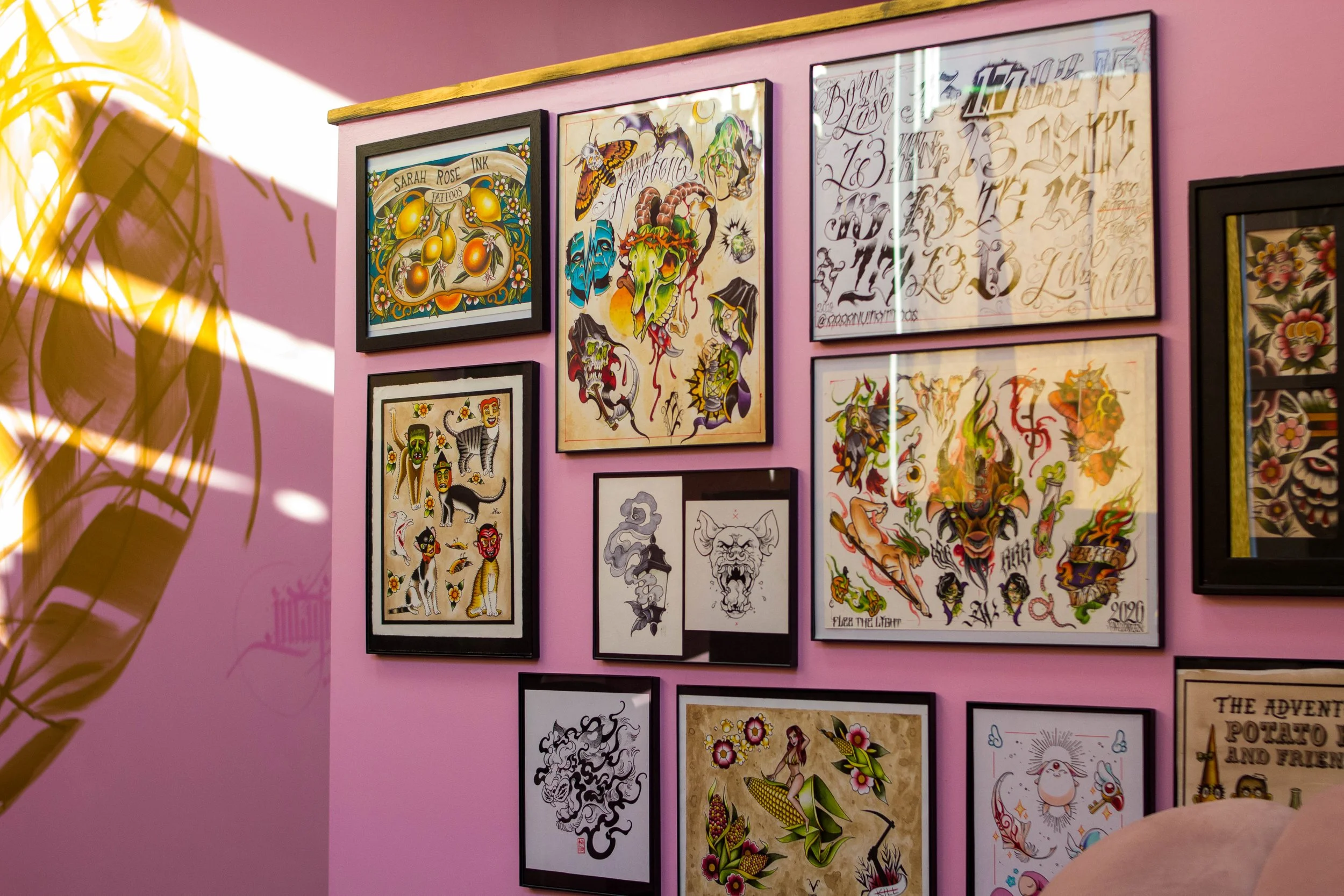
Pearl Street Tattoo Club
N: That's a testament to the environment that you've created!
A: Exactly. And like when we were making it, I was full of a lot of rage and anger. I've been very angry about racism since I've realised that I've had to be. I've been subject to it without knowing about it.
I wanted to channel that rage and anger into something productive rather than complaining about stuff, which is what I was doing. And I think it's easy to get angry and say, this isn't working and this is, this is stupid, and all that kind of thing, which is something I have done and I admit to being an angry person in the past, but channelling it into something productive is much more helpful.
N: I relate to that and I think that a lot of people will.
A: I was screaming into the void where people just don't care and I thought let me do something productive. And then the people who do care will come. If you build it, they will come and they sure do come.
“For subcultures like alt Asians, you feel like you're really disappointing your family at all times, yet you're disappointing yourself if you don't allow yourself to self-express”
N: I want to go back a bit and ask you how you got into the alternative scene? Are you influenced or connected to a particular subculture?
A: When I was younger I was not connected with my culture. I grew up in a very white school and area – no other Pakistanis. The only other Muslim boy was Saudi at school and I think that's literally it and he was a bit weird so I had no one really to connect to. And even at secondary school there was one other Muslim in my whole year again and she was in a different class. I really had no connection to my culture.
I fell into punk and emo because I didn’t like to be told what to do. My family were always like “cover up your arms, cover up your shoulders” and I hated that and then things like going to funerals and not being able to go to the burial part of the funeral – in Islamic culture you can't do that. I felt very disconnected because I didn't think a lot of things in my culture, my religion, were very fair, particularly on women so I fell into the punk subculture. Because of that I've always had my hair dyed since I was 15 because I didn't really feel connected to it. It's liking bright colours as well, but not feeling connected to your roots.
And I think, as you can see, I'm growing out my natural hair now, finally. And I feel a lot more connected to my culture lately. That’s not to say that’s not what punk is about, but it's kind of more about rebellion, isn't it? That's pretty much how I was growing up and I was a body piercer for a year as well in 2013 and I loved being a body piercer. I'm a scientist and doing science experiments is all about accuracy and stable hands and stuff so I was a natural at body piercing but it's just not a long-term career in the UK especially when you have Muslim, Pakistani parents. I don't think they even know I was a body piercer, but they do know I've got the tattoo shop.
N: What do your parents think about you co-owning a tattoo shop?
A: They're not happy about the tattoo shop really but they can understand that Arran is talented. It's kind of like a juxtaposition of them understanding that this is a really good talent and I'm good at business and this is a way we can thrive. We're doing really well, but they're not happy about it because tattoos are obviously haram, even though there’s no mention of tattoos in the Qur'an. There are cultures within Islam, for example underground Egyptian culture and a lot of cultures that do have tattoos. There's tattooing in Indian cultures and yeah, it's a little bit tricky in that respect. We still haven't had the talk about me having tattoos yet.
N: So they don’t know you've got tattoos?
A: I think they must guess, but we haven't had that conversation just yet. And I think they're scared to ask and I'm scared to tell.
N: Fair enough. We have a lot of readers who have to hide their tattoos and piercings from their family. Is there anything you would say to them?
A: What I would say is I see you and it's hard wanting to have self-expression in the form of tattoos and hear things, have to hide it, and living in a world where you wanna do what you want but you have to think about the community and shared culture.
It's really hard disappointing your parents. Even me with a PhD, with “doctor” in my name, I'm still scared of upsetting my parents. It’s such a universal experience, isn't it? For subcultures like alt Asians, you feel like you're really disappointing your family at all times, yet you're disappointing yourself if you don't allow yourself to self-express. By listening to music, getting tattoos, getting a nose piercing that your parents don't want you to get.
But you are gonna disappoint someone. You're either gonna disappoint yourself or your parents and it's a very fine line to cross, and I don't really know what else to say other than that because I'm still too scared as well. And I'm 31 with a baby and a marriage and a PhD and a tattoo shop. Well, I'm sure that's gonna make a lot of people feel a lot better.
N: Are there any final thoughts you’d like to leave our readers with?
A: I guess I wanna say tattoos are awesome and it’s so hard being yourself without disappointing people in our culture. But stay true to yourself!
About Naz
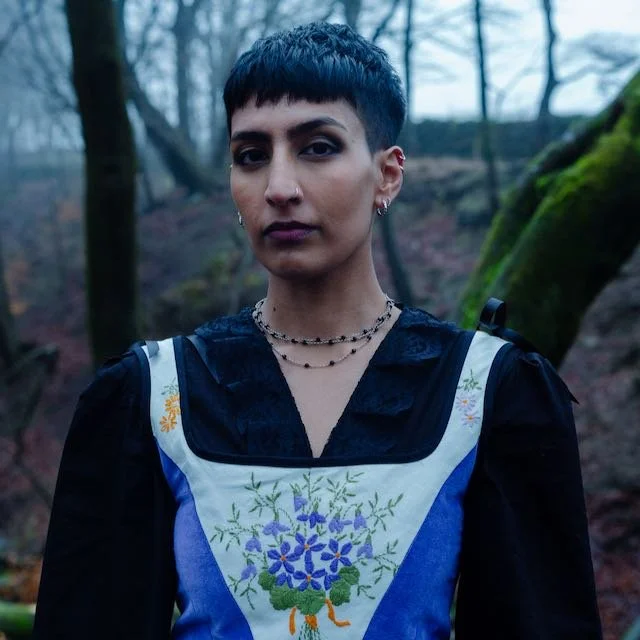
Naz Toorabally is a queer, British Indo-Mauritian musician and zine maker based in north London. She is the founder of WEIRDO Zine and fronts post-punk band Dogviolet. When she’s not making music or zines, you’ll find Naz hanging out with her cat.