Words by Aeka Joshi
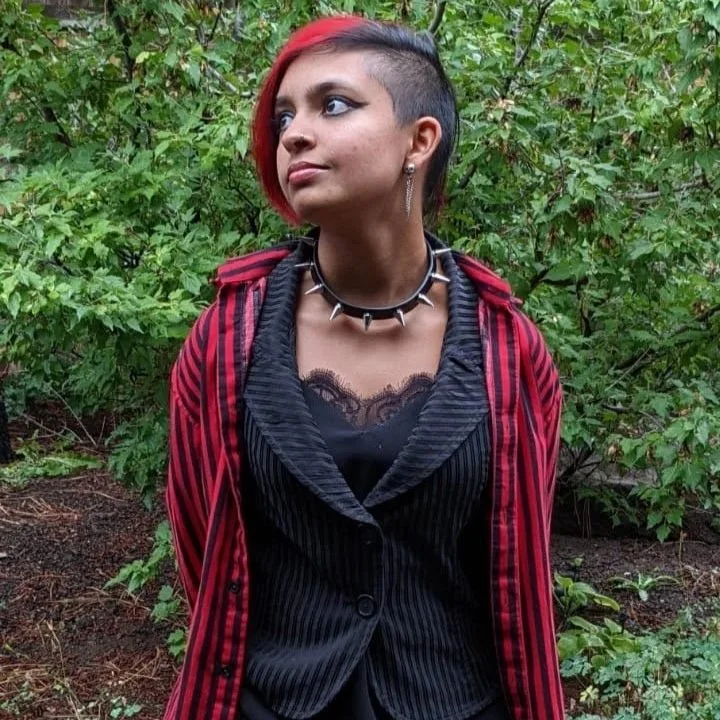
Growing up in a small, predominantly-white town as a person of colour is not easy, add being a goth to that and it’s a surefire way to attract playground bullies. Aeka Joshi shares her experiences as a young Indian goth and explains why she refuses to blend in.
This article was originally commissioned in 2022 for The Fashion Issue. The issue never made it to print, but we’re now sharing the articles with you on our website.
Growing up in a small, white Arizona town, a compliment frequently thrown my way is “exotic.” Exotic as in foreign, as in strange, as in not belonging. I find it odd that the people who surround me put so much emphasis on reminding me that I’m not like them.
I learned the art of blending in from switching back and forth between an American accent at school and an Indian accent at home, to memorising syrupy pop songs and Sanskrit slokas. This worked fine until it didn’t. As I got older, the other girls I grew up with turned pretty and washed the mud off their hands. And then there was me – stranded in no man’s land with a monobrow and teetering piles of fantasy novels.
Like most goths, I wasn’t born with chains and combat boots on – mostly because I’d never want to do that to my poor mom! – but as I got older, my nerdy obsession with the witches and misunderstood monsters I encountered in books and TV drew me towards the darker side of things. I was particularly fascinated by the ethereal-looking Morgana from the TV show Merlin, which I rewatched on repeat.
“The more love and support I find with my decidedly non-goth friends and family, the more fiercely myself I’m able to be.”
I attended a conservative prep school when I was thirteen where I was one of only two kids of Indian descent and branded the “resident weird goth” in my class. I was ostracised and bullied. It got worse when I chopped my long black hair short, donned my mother’s old black button down shirts and wore skirts that brushed my ankles. I was called “Columbine” for the oversized black leather coat used to wear – a callous reference to one of the gunmen of the 1999 Columbine High School massacre.
It was a small school, and rumours grew: I was a Satanist, I was going to have an arranged marriage, I’d given a girl twice my size a black eye (conveniently, her face remained unblemished). The bullying was incessant, with the school administration seemingly taking part in it. A day that stands vividly in my mind is when I was called into the office, where the assistant principal informed me that while she completely understood me – because she was the only white child in her school – my beloved coat and the rest of my attire were not acceptable and “reflected a very angry young woman.” Of course, I took that to be the compliment of the century, and it’s still the nicest thing anyone's ever said about me.
From the beginning, I had no choice but to stand out. I was different. Weird. Scary. It only makes sense that my armour of choice was my gothic clothing. I decided that if the people around me were xenophobic bigots, I might as well put the emphasis on the phobia and embrace all things dark and frightening.
“To choose to stand out on purpose, to defy ideas of what we are “supposed” to look like, is an act of self-determination.”
Fast forward to today, I’m still a goth, but a lot has changed. I’ve been lucky enough to be surrounded by people who love me for who I am – stripes, spikes, and all. The more love and support I find with my decidedly non-goth friends and family, the more fiercely myself I’m able to be. This has allowed me to experiment more with clothes and makeup, be it red eyeshadow that makes me look like a knockoff Frank Iero or Halloween costume jewellery. Ultimately, though, what has kept me true to myself is my refusal to ever be forced to be silent again. I am loud just by virtue of existing, and my clothing, makeup, and jewellery are no more or less than extensions of that.
The white goth and alternative community makes it abundantly clear that there is no space for people that look like me – skinny, big-mouthed, big-nosed and brown, not pale or soft or delicate. The Indian diaspora community in my town is no different, seemingly baffled by the shameless way I continue to take up space with my presence and dress like I escaped from a Lemony Snicket novel.
To me, making the choice to stand out with alternative clothing and style as a minority is to take back the right to define yourself. To choose to stand out on purpose, to defy ideas of what we are “supposed” to look like, is an act of self-determination. It’s a way of being seen and heard for who you are, of saying, “I will not shut up, and I will not disappear,” in a world that so often demands just that of young people of colour.
About Aeka
Aeka Joshi (she/her) is a reader, writer, and goth living in Flagstaff, Arizona. When not reading or writing, she can be found enjoying long walks with her very stubborn dachshund and getting trampled in mosh pits at local shows.