Book Review: Determination by Tawseef Khan
Words by Swetha Charles
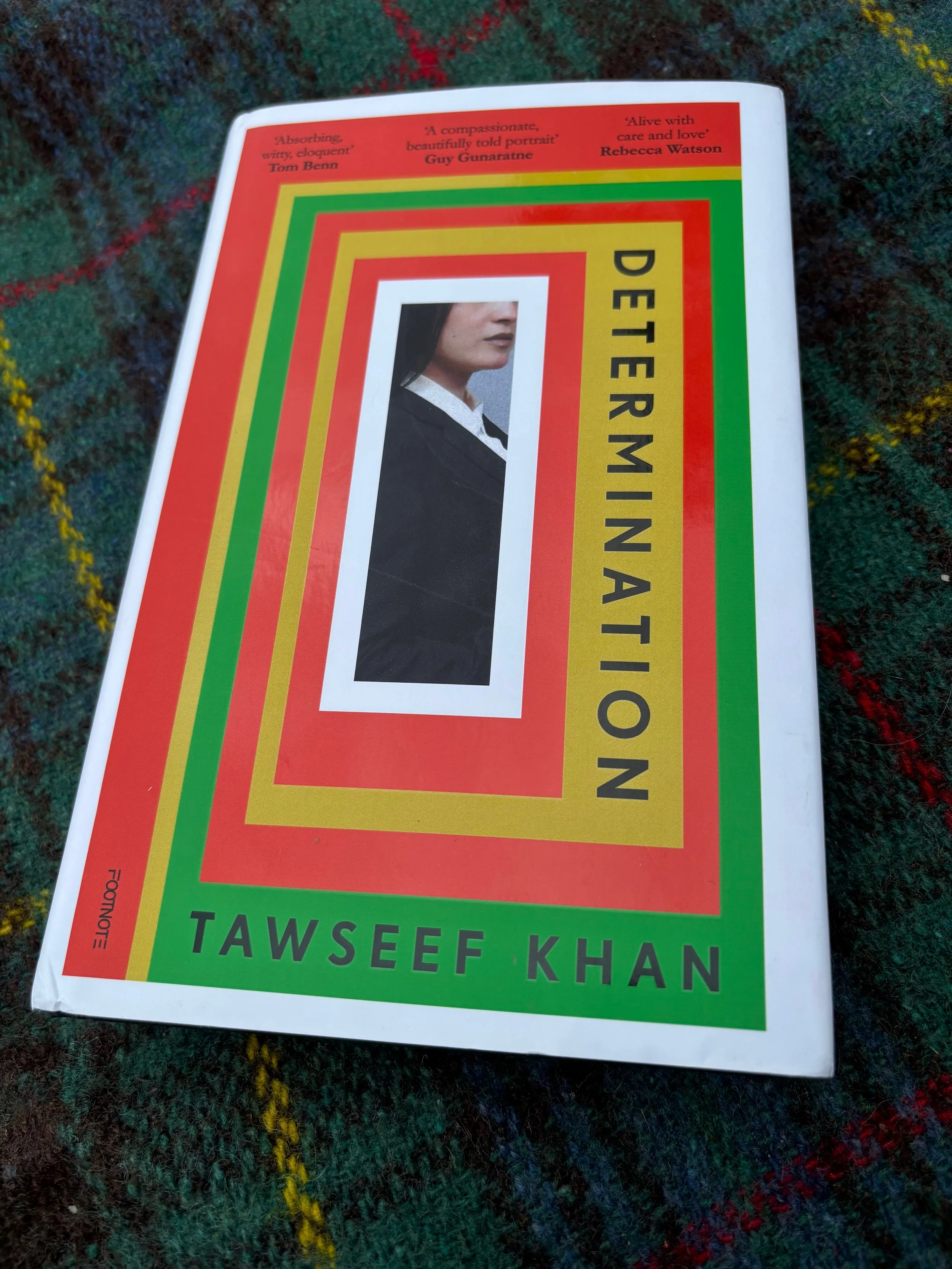
Determination by Tawseef Khan
Determination is the debut novel of Tawseef Khan, released in June 2024. Drawing on his background as an immigration solicitor, Tawseef’s Determination follows the story of immigration solicitor, Jamila Shah, as she runs the family law firm and navigates her clients through hostile immigration policies.
Reading Tawseef Khan's Determination is to travel back in time to when Theresa May was defining public policy and hostile immigration became the UK's defacto stance toward immigration. The book tells the story of a late twenties lawyer, Jamila Shah, who works in her family firm as an immigration lawyer. The firm is a mainstay with the local community and we meet Jamila when she has – through some combination of ambition and filial duty – taken over from her dad and been running it for around a year.
Through the novel, Khan compassionately examines the minutiae of the Jamila's client's lives, and shows us the difficulties faced by migrants in the UK. He uses multiple characters' perspectives to weave together an image of what it means to be an immigrant facing the capricious Home Office and its one too many requirements. There are also multiple parallels between the author and Jamila – Tawseef is himself a solicitor and he too has followed in his father's footsteps into law. In an article he wrote for Hyphen, Tawseef delves into his reasons for writing the book – his aim is to give close attention, agency and time to those navigating the world of immigration law. Though the number of parallel plots can sometimes rush the reader along, the multi character approach to the novel is certainly its strength and shows the impact of the legal labyrinth immigrants have to face on their lives.
One of the shocking stories Tawseef sketches for us is of a man who by all rights has his correct papers, but is nevertheless suddenly kidnapped by immigration enforcement, and detained without cause. He comes within an inch of being deported and then in a dizzying turn around, he is released without a word to his lawyer. Both Jamila and her client face uncertainty and a lack of control through this process. There is a distinct echo of ICE's deportations in the US and it also reminds us that being an immigrant has long been fraught in the UK. After his release, Jamila finds that the dehumanisation and trauma of his arrest and the threat deportation stay with this client. The message is clear to him: "you don't belong here". Any security he might have felt has been destroyed at a moments notice. We also see in the book the impact of the police vans with the egregious and racist "Go home" signs. The vans imply threat in every mile and are driven around specifically chosen areas, the same ones that Jamila works in. The message makes it clear again who is not accepted. Britain is happy to take: tikka masala after a night out, Afghan rugs lining the homes of the rich, cashmere sweaters gliding down the halls of power – but it does not want the people to whom these cultural artefacts belong.
One facet of immigration that stands out in the book is how the clients who come to Jamila are asked to prove again and again the validity of their stories. Khan, through detailing the hoops they have to jump through, shows how their journeys are viewed through a cloud of doubt – they are repeatedly tasked to prove that they are one of the "good" immigrants that deserve to stay. A queer client of Jamila's, in his desperation to prove that his sexual orientation is real, offers a tape of his partner and himself in an intimate moment. Jamila, while gently dissuading him from submitting this evidence also notes that while dignity and privacy are important and lauded concepts, they may seem too lofty when those who offer tapes have their visas stamped through within weeks. Without a tape, clients wait years. The result of the process is again dehumanisation; of having to judge the cost of either putting yourself on a platter and sharing what should be all rights remain private against the cost of a long and drawn out refugee process.
Another cost that immigrants face with these hostile policies is the lack of space to make mistakes. We follow 19 year old Khalil who is applying for citizenship, and who has grown up in the UK for years – he is by all rights more British than anything else. On a night out he makes a regrettable mistake and punches someone in response to racial abuse. The altercation culminates in a caution for Kahlil. Years later, filling in his application in Jamila's office, he is scared to admit to this infraction in front of his uncle. When he does disclose his run-in with the law, both Jamila and Kahlil realise with fear that the Home Office may or may not discover this in Kahlil's history. Suddenly, the spectre deportation looms over his future. What would have been an ill thought out teenage mistake for anyone else instead becomes a mistake that could upend Kahlil's life. No-one is perfect but for immigrants, the expectation is of perfection.
An oft repeated character in the book, Hassan, turns up insistently at Jamila's office. He blows up her phone, comes laden with numerous requests and no matter what, is difficult to please. Jamila works through his case with him, making time and spending energy that she doesn't have. In the end, when his case is denied, he lashes out and lodges a complaint against her. Throughout, his case is difficult and made particularly so as in interviews he often verbally contradicts what is laid out in his paperwork. As his story unfolds we realise that he has been trying hard to hide his true experiences for fear of being seen as weak. His trauma clouds the evidence he can give in front of someone else. It’s clear that there is no room in this present immigration system for the humanity and pain of those who have had difficult journeys when seeking refuge.
Jamila's aim throughout the novel is to help her clients. But another extremely important point that Tawseef explores is her need to also draw boundaries around her work. Valiantly, we follow her as she tries hard to stop her work taking over her entire life – both for her own sanity but also to prevent her from burning out and finding herself no longer able to do the work she loves. Her struggles to draw limits around her work come into relief when we see her wrestling with the decision to take on her co-worker’s case adding to her already burgeoning workload or to recommend him to a fellow lawyer. Tawseef’s personal experience as an immigration lawyer perhaps explains how well the book shows the difficulty of balancing the importance of this work against the importance of rest.
In Determination, through Kahlil's, Hassan's, Jamila's and countless other stories, we see the immense pain inflicted by the hostile immigration policy. The lives in the novel show the cost that the rise of fascism and increased anti immigrant and xenophobic sentiments have on innocent people. Tawseef Khan uses these stories to look tenderly and honestly at the lives of those who move countries to make their home in a different land. The book is a reminder in this hostile climate that there are different ways of viewing immigration. Instead of writing about these immigrants' lives through a haze of suspicion and doubt, Khan shows us we can instead approach migrants’ stories with kindness and empathy, humanising their journey that has brought them to the UK
About Swetha

Swetha Charles, originally from Chennai and currently based in north London, is a software engineer by day and a writer and organiser by twilight. She loves books, both collecting and reading, making seasonal playlists and hanging out with her very fluffy cat Pinto.